
OTTAWA (December 18, 2025):
Canadians are paying more for government than at any point in history, yet provincial public services are delivering weaker results. Across the country, governments have grown larger and more expensive, while performance in health care, education, and core services has steadily declined.
In The Provincial Productivity Crisis: How better measurement, management, and modernization can improve outcomes, the third and final report in a three-part series, economist Stephen Tapp examines how the size and efficiency of provincial governments compare across Canada and how those differences shape the services Canadians receive.
Using two composite indicators, the Size of Government Index (SGI) and the Government Productivity Index (GPI), the report finds that every province has expanded the size of its government sector, while government productivity has declined everywhere.
“Without sustained productivity improvements, larger governments risk translating into higher fiscal burdens rather than improved outcomes,” writes Tapp.
Health care is the primary driver of government expansion in every province, yet outcomes continue to worsen. Median wait times for treatment have increased nationwide, particularly in Atlantic Canada, even as employment and compensation in the health sector surged.
Education outcomes tell a similar story. The Programme for International Student Assessment (PISA) test scores for Canadian students have declined in every province over the past two decades, with the weakest results concentrated in provinces with the largest government sectors.
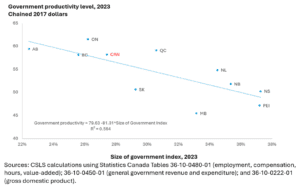
The report also finds that larger governments don’t necessarily deliver better services or better value for money. Provinces with higher government productivity levels tend to operate smaller public sectors, while provinces with lower productivity often maintain the largest government sectors.
Tapp warns that with aging populations, limited fiscal room, and rising expectations, provinces cannot simply spend their way out of declining performance.
The report concludes with a three pillar reform agenda: measure, manage, and modernize. Tapp calls on governments to strengthen performance measurement, link resources to results, and modernize service delivery through digital transformation and emerging technologies.
Without a renewed focus on productivity, Tapp cautions, Canadians should expect bigger governments and weaker outcomes in the years ahead.
“If productivity becomes a defining benchmark of public-sector success, Canadians will be better positioned to meet the fiscal, demographic, and social challenges of the coming decades.”
To learn more, read the full paper here:

Stephen Tapp is the CEO and chief economist at the Centre for the Study of Living Standards (CSLS).
For further information, media are invited to contact:
media@macdonaldlaurier.ca