Wednesday, March 11, 2026
No Result
View All Result
  • Media
Macdonald-Laurier Institute
  • Home
  • About
    • Who We Are
    • Who Makes MLI Work
    • Fifteenth Anniversary
  • Experts
    • Experts Directory
    • In Memoriam
  • Issues
    • Domestic Policy
      • Economic Policy
      • Justice
      • Rights and Freedoms
      • Assisted Suicide (MAID)
      • Health Care
      • COVID-19
      • Gender Identity
      • Canada’s Political Tradition
      • AI, Technology and Innovation
      • Media and Telecoms
      • Housing
      • Immigration
      • Agriculture and Agri-Food
      • Competition Policy
    • Energy Policy
      • Energy
      • Environment
    • Foreign Policy
      • Israel-Hamas War
      • Ukraine
      • Taiwan
      • China
      • Europe and Russia
      • Indo-Pacific
      • Middle East and North Africa
      • North America
      • Foreign Interference
      • National Defence
      • National Security
      • Foreign Affairs
    • Indigenous Affairs
  • Projects
    • CNAPS (Center for North American Prosperity and Security)
    • Justice Report Card
    • The Promised Land
    • Voices that Inspire: The Macdonald-Laurier Vancouver Speaker Series
    • Dragon at the door
    • Canada on top of the world
    • Letter to a minister
    • The Great Energy Crisis
    • DisInfoWatch.org
    • Managing Indigenous Prosperity
    • Judicial Foundations
    • Landmark Cases Council
    • Defending The Marketplace of Ideas
    • Reforming the University
    • Past Projects
      • Digital Policy & Connectivity
      • Double Trouble
      • Canada and the Indo-Pacific Initiative
      • The Transatlantic Program
      • COVID Misery Index
        • Provincial COVID Misery Index
        • Beyond Lockdown
        • COVID and after: A mandate for recovery
      • Speak for Ourselves
      • The Eavesdropping Dragon: Huawei
      • Talkin’ in the Free World with Mariam Memarsadeghi
      • An Intellectual Property Strategy for Canada
      • Munk Senior Fellows
      • A Mandate for Canada
      • Confederation Series
      • Fiscal Reform
      • The Canadian Century project
      • Fixing Canadian health care
      • Internal trade
      • From a mandate for change
      • Size of government in Canada
      • Straight Talk
      • Labour Market Report
      • Leading Economic Indicator
      • Centre for Advancing Canada’s Interests Abroad
      • Indigenous Prosperity at a Crossroads
        • Aboriginal Canada and Natural Resources
  • Events
    • Upcoming Events
    • Past Events
      • MLI Dinners
      • Great Canadian Debates
  • Latest News
  • Libraries
    • Columns
    • Commentary
    • Papers
    • Books
    • Video
  • Donate
  • Home
  • About
    • Who We Are
    • Who Makes MLI Work
    • Fifteenth Anniversary
  • Experts
    • Experts Directory
    • In Memoriam
  • Issues
    • Domestic Policy
      • Economic Policy
      • Justice
      • Rights and Freedoms
      • Assisted Suicide (MAID)
      • Health Care
      • COVID-19
      • Gender Identity
      • Canada’s Political Tradition
      • AI, Technology and Innovation
      • Media and Telecoms
      • Housing
      • Immigration
      • Agriculture and Agri-Food
      • Competition Policy
    • Energy Policy
      • Energy
      • Environment
    • Foreign Policy
      • Israel-Hamas War
      • Ukraine
      • Taiwan
      • China
      • Europe and Russia
      • Indo-Pacific
      • Middle East and North Africa
      • North America
      • Foreign Interference
      • National Defence
      • National Security
      • Foreign Affairs
    • Indigenous Affairs
  • Projects
    • CNAPS (Center for North American Prosperity and Security)
    • Justice Report Card
    • The Promised Land
    • Voices that Inspire: The Macdonald-Laurier Vancouver Speaker Series
    • Dragon at the door
    • Canada on top of the world
    • Letter to a minister
    • The Great Energy Crisis
    • DisInfoWatch.org
    • Managing Indigenous Prosperity
    • Judicial Foundations
    • Landmark Cases Council
    • Defending The Marketplace of Ideas
    • Reforming the University
    • Past Projects
      • Digital Policy & Connectivity
      • Double Trouble
      • Canada and the Indo-Pacific Initiative
      • The Transatlantic Program
      • COVID Misery Index
        • Provincial COVID Misery Index
        • Beyond Lockdown
        • COVID and after: A mandate for recovery
      • Speak for Ourselves
      • The Eavesdropping Dragon: Huawei
      • Talkin’ in the Free World with Mariam Memarsadeghi
      • An Intellectual Property Strategy for Canada
      • Munk Senior Fellows
      • A Mandate for Canada
      • Confederation Series
      • Fiscal Reform
      • The Canadian Century project
      • Fixing Canadian health care
      • Internal trade
      • From a mandate for change
      • Size of government in Canada
      • Straight Talk
      • Labour Market Report
      • Leading Economic Indicator
      • Centre for Advancing Canada’s Interests Abroad
      • Indigenous Prosperity at a Crossroads
        • Aboriginal Canada and Natural Resources
  • Events
    • Upcoming Events
    • Past Events
      • MLI Dinners
      • Great Canadian Debates
  • Latest News
  • Libraries
    • Columns
    • Commentary
    • Papers
    • Books
    • Video
  • Donate
No Result
View All Result
Macdonald-Laurier Institute

Iran just tested NATO’s perimeter: Joe Varner in Real Clear World

The broader lesson is that modern conflicts rarely remain confined to the locations where they begin.

March 11, 2026
in Foreign Affairs, Latest News, Columns, Foreign Policy, In the Media, Middle East and North Africa, Joe Varner
Reading Time: 4 mins read
A A
Iran just tested NATO’s perimeter: Joe Varner in Real Clear World

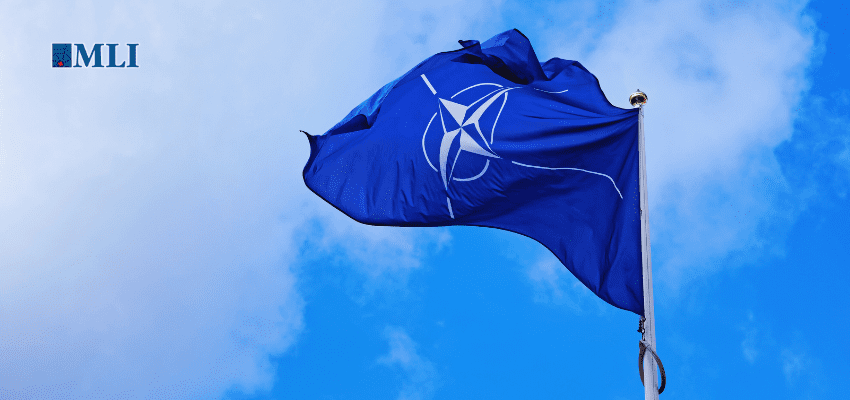
Image via Canva.

This article originally appeared in Real Clear World.

By Joe Varner, March 11, 2026

The war between the U.S., Israel, and Iran is beginning to reshape the strategic environment well beyond the Middle East. What began as a campaign aimed at Iran’s leadership and military infrastructure has already begun to affect NATO members and their installations across the wider region. Iranian retaliation has reached locations connected to Western forces and forced European governments to reassess the security of their personnel, bases, and maritime routes in the eastern Mediterranean.

One of the clearest examples occurred when Iranian drones struck the British air base at RAF Akrotiri in Cyprus. The base is one of the United Kingdom’s most important overseas military facilities and a key hub for Western operations in the Middle East. Although the damage was limited, the attack demonstrated that Iranian retaliation could extend to installations associated with NATO countries. In response, Britain announced strengthened defensive measures around its sovereign base areas on Cyprus. Greece has also dispatched a warship to help defend the island and assist in protecting the British facilities there. These steps have created a cooperative defensive posture around Cyprus among several European partners concerned about further Iranian attacks.

The conflict has also brushed directly against NATO territory. A missile launched from Iran toward Turkey was intercepted by NATO air defenses. The incident marked the first time during the current war that an Iranian strike threatened the territory of a NATO member state. Although the missile was destroyed before impact, the event highlighted how easily the conflict could intersect with the alliance’s security commitments if escalation continues.

Iranian retaliation has also affected Western military infrastructure elsewhere in the region. Reports indicate that Iranian strikes have targeted facilities connected to European forces, including an Italian installation in Iraq and Kuwait, and a French naval facility in the United Arab Emirates. These attacks demonstrate that Iran is willing to widen its response beyond Israel and the U.S. to include states viewed as supporting or facilitating the campaign against Tehran. European governments have begun strengthening their military posture in response. France has assembled a significant naval presence across the Mediterranean and nearby waters. The aircraft carrier Charles de Gaulle and its strike group have moved through the Strait of Gibraltar while additional French naval vessels have taken positions across the eastern Mediterranean, the Red Sea, and the Arabian Sea. These deployments are precautionary measures intended to protect maritime trade routes, reinforce Western military positions, and prepare evacuation plans for civilians should the conflict widen further.

Taken together, these developments show how quickly a regional war can begin to affect the broader alliance environment surrounding NATO. European forces are reinforcing bases, deploying naval assets, and increasing defensive measures even though NATO as an institution has not entered the conflict directly. The alliance now faces the reality that instability in the Middle East can intersect with its security responsibilities while Russia continues its war in Ukraine.

For Canada the implications are real even though Ottawa has ruled out participation in the air campaign against Iran. Canada remains integrated with NATO and Coalition operations and planning structures. If Iranian attacks continue to affect installations used by alliance members, pressure could grow for coordinated defensive measures that involve intelligence cooperation, maritime patrols, or reinforcement of allied deployments. Canada has traditionally contributed to these types of coalition activities in the Persian Gulf and could be called upon to support them again if the security environment around NATO’s southern flank deteriorates further.

The broader lesson is that modern conflicts rarely remain confined to the locations where they begin. Long-range missiles, drones, and global military networks mean that wars can quickly reach beyond their original theatre. The conflict involving Iran, Israel, and the U.S. already touches multiple regions and involves infrastructure connected to many countries. NATO may not be a participant in the war, but the alliance is increasingly part of the strategic environment surrounding it.

As the conflict develops, the alliance will need to balance its attention between several challenges at once. European security remains under pressure from Russia while instability across the Middle East creates new risks along NATO’s southern approaches. The war now unfolding around Iran may yet become another test of the alliance’s ability to manage overlapping crises in a rapidly changing international security landscape.


Joe Varner is deputy director of the Conference of Defence Associations in Ottawa, a senior fellow at the Macdonald-Laurier Institute, and a senior fellow at the Center for North American Prosperity and Security in Washington, D.C.
Source: Real Clear World

Related Posts

Carney is good news for the CBC, and bad news for the rest: Peter Menzies in The Line
Media and Telecoms

Getting in bed with the CRTC is a big mistake for Canadian media—so of course they’re eager to do it: Peter Menzies in The Hub

March 11, 2026
Screenshot Alain Bartleman
Latest News

Alain Bartleman on how Canada’s courts are reshaping Indigenous rights and economic development

March 11, 2026
Could Iran’s Regime Collapse?: Kaveh Sharhooz on Quillette
Middle East and North Africa

Could Iran’s Regime Collapse?: Kaveh Sharhooz on Quillette

March 10, 2026
Next Post
Carney is good news for the CBC, and bad news for the rest: Peter Menzies in The Line

Getting in bed with the CRTC is a big mistake for Canadian media—so of course they’re eager to do it: Peter Menzies in The Hub

Newsletter Signup

  Thank you for Signing Up
  Please correct the marked field(s) below.
Email Address  *
1,true,6,Contact Email,2
First Name *
1,true,1,First Name,2
Last Name *
1,true,1,Last Name,2
*
*Required Fields

Follow us on

Macdonald-Laurier Institute

323 Chapel Street, Suite #300
Ottawa, Ontario, K1N 7Z2 Canada

613.482.8327

info@macdonaldlaurier.ca
MLI directory

Support Us

Support the Macdonald-Laurier Institute to help ensure that Canada is one of the best governed countries in the world. Click below to learn more or become a sponsor.

Support Us

  • Inside Policy Magazine
  • Annual Reports
  • Jobs
  • Privacy Policy

© 2023 Macdonald-Laurier Institute. All Rights reserved.

No Result
View All Result
  • Home
  • About
    • Who We Are
    • Who Makes MLI Work
    • Fifteenth Anniversary
  • Experts
    • Experts Directory
    • In Memoriam
  • Issues
    • Domestic Policy
      • Economic Policy
      • Justice
      • Rights and Freedoms
      • Assisted Suicide (MAID)
      • Health Care
      • COVID-19
      • Gender Identity
      • Canada’s Political Tradition
      • AI, Technology and Innovation
      • Media and Telecoms
      • Housing
      • Immigration
      • Agriculture and Agri-Food
      • Competition Policy
    • Energy Policy
      • Energy
      • Environment
    • Foreign Policy
      • Israel-Hamas War
      • Ukraine
      • Taiwan
      • China
      • Europe and Russia
      • Indo-Pacific
      • Middle East and North Africa
      • North America
      • Foreign Interference
      • National Defence
      • National Security
      • Foreign Affairs
    • Indigenous Affairs
  • Projects
    • CNAPS (Center for North American Prosperity and Security)
    • Justice Report Card
    • The Promised Land
    • Voices that Inspire: The Macdonald-Laurier Vancouver Speaker Series
    • Dragon at the door
    • Canada on top of the world
    • Letter to a minister
    • The Great Energy Crisis
    • DisInfoWatch.org
    • Managing Indigenous Prosperity
    • Judicial Foundations
    • Landmark Cases Council
    • Defending The Marketplace of Ideas
    • Reforming the University
    • Past Projects
      • Digital Policy & Connectivity
      • Double Trouble
      • Canada and the Indo-Pacific Initiative
      • The Transatlantic Program
      • COVID Misery Index
      • Speak for Ourselves
      • The Eavesdropping Dragon: Huawei
      • Talkin’ in the Free World with Mariam Memarsadeghi
      • An Intellectual Property Strategy for Canada
      • Munk Senior Fellows
      • A Mandate for Canada
      • Confederation Series
      • Fiscal Reform
      • The Canadian Century project
      • Fixing Canadian health care
      • Internal trade
      • From a mandate for change
      • Size of government in Canada
      • Straight Talk
      • Labour Market Report
      • Leading Economic Indicator
      • Centre for Advancing Canada’s Interests Abroad
      • Indigenous Prosperity at a Crossroads
  • Events
    • Upcoming Events
    • Past Events
      • MLI Dinners
      • Great Canadian Debates
  • Latest News
  • Libraries
    • Columns
    • Commentary
    • Papers
    • Books
    • Video
  • Donate

© 2023 Macdonald-Laurier Institute. All Rights reserved.