Tuesday, February 17, 2026
No Result
View All Result
  • Media
Macdonald-Laurier Institute
  • Home
  • About
    • Who We Are
    • Who Makes MLI Work
    • Fifteenth Anniversary
  • Experts
    • Experts Directory
    • In Memoriam
  • Issues
    • Domestic Policy
      • Economic Policy
      • Justice
      • Rights and Freedoms
      • Assisted Suicide (MAID)
      • Health Care
      • COVID-19
      • Gender Identity
      • Canada’s Political Tradition
      • AI, Technology and Innovation
      • Media and Telecoms
      • Housing
      • Immigration
      • Agriculture and Agri-Food
      • Competition Policy
    • Energy Policy
      • Energy
      • Environment
    • Foreign Policy
      • Israel-Hamas War
      • Ukraine
      • Taiwan
      • China
      • Europe and Russia
      • Indo-Pacific
      • Middle East and North Africa
      • North America
      • Foreign Interference
      • National Defence
      • National Security
      • Foreign Affairs
    • Indigenous Affairs
  • Projects
    • CNAPS (Center for North American Prosperity and Security)
    • The Promised Land
    • Voices that Inspire: The Macdonald-Laurier Vancouver Speaker Series
    • Dragon at the door
    • Canada on top of the world
    • Letter to a minister
    • Justice Report Card
    • The Great Energy Crisis
    • DisInfoWatch.org
    • Managing Indigenous Prosperity
    • Judicial Foundations
    • Landmark Cases Council
    • Defending The Marketplace of Ideas
    • Reforming the University
    • Past Projects
      • Digital Policy & Connectivity
      • Double Trouble
      • Canada and the Indo-Pacific Initiative
      • The Transatlantic Program
      • COVID Misery Index
        • Provincial COVID Misery Index
        • Beyond Lockdown
        • COVID and after: A mandate for recovery
      • Speak for Ourselves
      • The Eavesdropping Dragon: Huawei
      • Talkin’ in the Free World with Mariam Memarsadeghi
      • An Intellectual Property Strategy for Canada
      • Munk Senior Fellows
      • A Mandate for Canada
      • Confederation Series
      • Fiscal Reform
      • The Canadian Century project
      • Fixing Canadian health care
      • Internal trade
      • From a mandate for change
      • Size of government in Canada
      • Straight Talk
      • Labour Market Report
      • Leading Economic Indicator
      • Centre for Advancing Canada’s Interests Abroad
      • Indigenous Prosperity at a Crossroads
        • Aboriginal Canada and Natural Resources
  • Events
    • Upcoming Events
    • Past Events
      • MLI Dinners
      • Great Canadian Debates
  • Latest News
  • Libraries
    • Columns
    • Commentary
    • Papers
    • Books
    • Video
  • Donate
  • Home
  • About
    • Who We Are
    • Who Makes MLI Work
    • Fifteenth Anniversary
  • Experts
    • Experts Directory
    • In Memoriam
  • Issues
    • Domestic Policy
      • Economic Policy
      • Justice
      • Rights and Freedoms
      • Assisted Suicide (MAID)
      • Health Care
      • COVID-19
      • Gender Identity
      • Canada’s Political Tradition
      • AI, Technology and Innovation
      • Media and Telecoms
      • Housing
      • Immigration
      • Agriculture and Agri-Food
      • Competition Policy
    • Energy Policy
      • Energy
      • Environment
    • Foreign Policy
      • Israel-Hamas War
      • Ukraine
      • Taiwan
      • China
      • Europe and Russia
      • Indo-Pacific
      • Middle East and North Africa
      • North America
      • Foreign Interference
      • National Defence
      • National Security
      • Foreign Affairs
    • Indigenous Affairs
  • Projects
    • CNAPS (Center for North American Prosperity and Security)
    • The Promised Land
    • Voices that Inspire: The Macdonald-Laurier Vancouver Speaker Series
    • Dragon at the door
    • Canada on top of the world
    • Letter to a minister
    • Justice Report Card
    • The Great Energy Crisis
    • DisInfoWatch.org
    • Managing Indigenous Prosperity
    • Judicial Foundations
    • Landmark Cases Council
    • Defending The Marketplace of Ideas
    • Reforming the University
    • Past Projects
      • Digital Policy & Connectivity
      • Double Trouble
      • Canada and the Indo-Pacific Initiative
      • The Transatlantic Program
      • COVID Misery Index
        • Provincial COVID Misery Index
        • Beyond Lockdown
        • COVID and after: A mandate for recovery
      • Speak for Ourselves
      • The Eavesdropping Dragon: Huawei
      • Talkin’ in the Free World with Mariam Memarsadeghi
      • An Intellectual Property Strategy for Canada
      • Munk Senior Fellows
      • A Mandate for Canada
      • Confederation Series
      • Fiscal Reform
      • The Canadian Century project
      • Fixing Canadian health care
      • Internal trade
      • From a mandate for change
      • Size of government in Canada
      • Straight Talk
      • Labour Market Report
      • Leading Economic Indicator
      • Centre for Advancing Canada’s Interests Abroad
      • Indigenous Prosperity at a Crossroads
        • Aboriginal Canada and Natural Resources
  • Events
    • Upcoming Events
    • Past Events
      • MLI Dinners
      • Great Canadian Debates
  • Latest News
  • Libraries
    • Columns
    • Commentary
    • Papers
    • Books
    • Video
  • Donate
No Result
View All Result
Macdonald-Laurier Institute

How Canada and allies can stand up to Trump and other great-power bullies: Fen Osler Hampson and Tim Sargent in the Globe and Mail

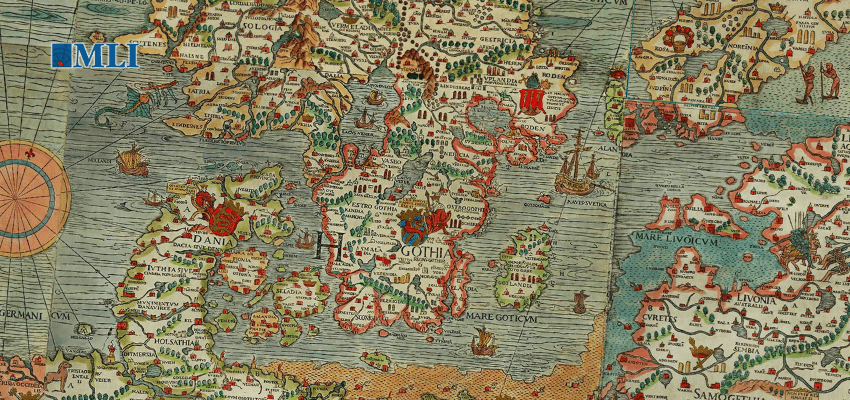
Drawing from the Hanseatic League, a 13th-century alliance, could help middle powers leverage their strengths.

February 17, 2026
in Foreign Affairs, Latest News, Columns, Foreign Policy, In the Media, Europe and Russia, Economic Policy, North America, Tim Sargent
Reading Time: 5 mins read
A A
How Canada and allies can stand up to Trump and other great-power bullies: Fen Osler Hampson and Tim Sargent in the Globe and Mail

Image via Wikimedia Commons.

This article originally appeared in the Globe and Mail.

By Fen Osler Hampson and Tim Sargent, February 17, 2026

Prime Minister Mark Carney won many plaudits for his recent speech to the World Economic Forum in Davos, Switzerland, in which he warned that the rules-based economic order is over, and that “middle powers” such as Canada must work together against great-power coercion. The speech continued making waves at last week’s Munich Security Conference.

But talk is cheap and applause is free. And the blowback from U.S. President Donald Trump has been harsh and long-lingering. Also last week, Mr. Trump threatened to block a new Windsor-Detroit bridge and demanded to be “fully compensated for everything we have given” to Canada – despite the fact that Canada paid for the entire project.

Without a concrete proposal for rallying the middle powers, the Prime Minister might have been better to confine himself to the usual platitudes of high-level international meetings, and to avoid antagonizing the world’s most powerful country. He needs to follow up, and quickly. The “rupture” to the world order, as Mr. Carney calls it, hits a trading nation such as Canada particularly hard. Without action to back up Mr. Carney’s words, our lives will get harder and meaner.

Canada, along with other advanced democracies such as Britain, Norway, Japan, South Korea, Australia, New Zealand and the countries of the European Union, should look beyond traditional diplomacy. They should seek to establish a 21st-century version of the Hanseatic League: an informal alliance of hundreds of cities and merchant guilds along the North and Baltic coasts in medieval times. This group, which grew out of German towns, successfully formed a commercial and defensive network to stave off the predations of neighbouring states such as Denmark, England and Russia.

The power of such an alliance today would come not from military strength, but from the sophisticated market-power leverage these countries exercise over global finance and trade.
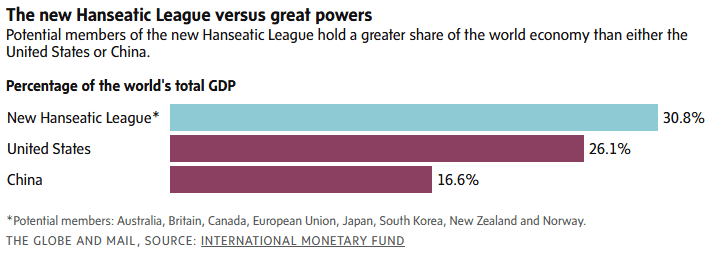
A key lesson from the recent skirmish over President Trump’s ambition to acquire Greenland is not just the pushback he got from some leaders at Davos; it is also the market reaction to the possibility that European creditors might start to dump U.S. bonds if the conflict escalated into a full-blown trade war.

The true Achilles’ heel of the U.S. is its exposure to its creditors and foreign investors, with its net foreign debt – public and private – now standing at more than $27-trillion, compared to only $8-trillion a decade ago. When the threat of instability begins to manifest itself as a spike in bond yields (which move inversely with prices) or a sudden decline in share prices, the economic costs of predatory behaviour are immediately apparent.

Between the sovereign wealth funds of Norway and Australia, the massive pension portfolios of Canada, Britain and many EU members, and the government bond holdings of Japan, these countries together control a critical mass of global liquidity. By themselves, each is not enough to make the United States blink. But if they were to coordinate their risk assessments, this group could act as a kind of global financial security council.
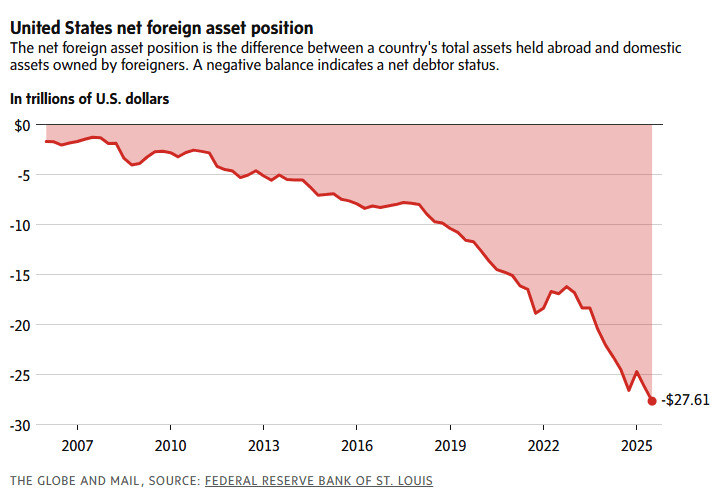
If a great power engaged in behaviour that undermines international stability through economic coercion or a violation of state sovereignty, the world’s middle powers could signal their plans to recalibrate their vast financial holdings. A coordinated shift in the bond holdings or a staged reassessment of a great power’s sovereign risk premium would trigger an immediate market reaction, forcing a predatory actor to reassess its geopolitical ambitions.

These countries are also large economies in their own right. Our new Hanseatic League of advanced democracies accounts for 30 per cent of world’s gross domestic product (measured in U.S. dollars). This is very relevant for dealing with China, the other great power that is not afraid to menace smaller countries.

Unlike the U.S., China is a net creditor country, and so is not vulnerable to a coordinated retreat from its asset markets. However, this net asset position has been built up by chronic trade surpluses, generated by an economy that produces way more than it can consume. As a result, China would be quite vulnerable to a coordinated action to restrict its exports, which would shutter factories and lead to the kind of social unrest that the communist regime seeks to avoid at all costs.

The key organizing principle of the league should be an economic equivalent of NATO’s Article 5: an attack against one is an attack against all. This collective defence mechanism would neutralize the “divide-and-conquer” strategy employed by great powers, transforming a bilateral dispute into a confrontation with a powerful and unified coalition.

As with its military counterpart, the new league should have a permanent secretariat that could war-game potential threats and responses, while maintaining continuous informal communications between central bankers, fund managers, finance ministers and political leaders.

How can Canada make this happen?

The first step would be for the Prime Minister, fresh from his Davos success, to talk to other leaders to rally them to this cause. This should not be too difficult, given their reactions to Mr. Carney’s speech and how their moment of unity carried the day at the forum. Moreover, there is an existing platform off which to build: Canada has already set up the Ottawa Group, a collection of middle powers including the EU that has sought to preserve a rules-based trading system.

Mr. Carney should then bring the leaders together for an inaugural meeting that would make clear the league’s willingness to use its collective economic and financial muscle. Canada could offer to host the secretariat in Ottawa and provide the necessary resources. This kind of convening role is well suited to Canada’s diplomatic strengths: We were heavily involved in the creation of original postwar international institutions, such as the UN or NATO itself.

Of course, there are risks. Neither the U.S. nor China is likely to welcome such an alliance, and Canada, with its dependence on the American economy, may be particularly vulnerable. Economic and financial coercive measures also carry a cost for the states imposing them. A coordinated sell-off of U.S. bonds, for example, pushes down their value and hurts the countries selling them, too.

However, standing up for oneself always carries a price, no matter the method, and that price is small compared to the cost of rolling over. We are less dependent on the United States than Mr. Trump likes to think: The reality is that the U.S. trades with Canada not because it likes us, but because it needs our energy and raw materials.

Both President Trump and Chinese President Xi Jinping have made it abundantly clear that they respect only strength. “Going along to get along” will simply mean an endless series of concessions. The path forward for middle powers lies in recognizing that their strength is primarily financial and economic over military.

A fit-for-purpose Hanseatic League for the 21st century would send a strong message that power in the international system does not just reside in Washington or Beijing, but also with the world’s Lilliputians.


Fen Osler Hampson is Chancellor’s Professor at Carleton University.

Tim Sargent is director of domestic policy at the Macdonald-Laurier Institute and a former deputy minister of trade.
Source: The Globe and Mail
Tags: Fen Osler Hampson

Related Posts

Major U.S. medical groups take science-based approach to ‘gender-affirming’ care: Mia Hughes in the National Post
Gender Identity

Major U.S. medical groups take science-based approach to ‘gender-affirming’ care: Mia Hughes in the National Post

February 17, 2026
First Nations don’t need saving—they need government to get out of the way: Karen Restoule in The Hub
Indigenous Affairs

First Nations don’t need saving—they need government to get out of the way: Karen Restoule in The Hub

February 17, 2026
Threat convergence – transnational organized crime, terrorism, and hybrid warfare: Calvin Chrustie and John Gilmour for Inside Policy
National Security

Threat convergence – transnational organized crime, terrorism, and hybrid warfare: Calvin Chrustie and John Gilmour for Inside Policy

February 17, 2026
Next Post
Threat convergence – transnational organized crime, terrorism, and hybrid warfare: Calvin Chrustie and John Gilmour for Inside Policy

Threat convergence – transnational organized crime, terrorism, and hybrid warfare: Calvin Chrustie and John Gilmour for Inside Policy

Newsletter Signup

  Thank you for Signing Up
  Please correct the marked field(s) below.
Email Address  *
1,true,6,Contact Email,2
First Name *
1,true,1,First Name,2
Last Name *
1,true,1,Last Name,2
*
*Required Fields

Follow us on

Macdonald-Laurier Institute

323 Chapel Street, Suite #300
Ottawa, Ontario, K1N 7Z2 Canada

613.482.8327

info@macdonaldlaurier.ca
MLI directory

Support Us

Support the Macdonald-Laurier Institute to help ensure that Canada is one of the best governed countries in the world. Click below to learn more or become a sponsor.

Support Us

  • Inside Policy Magazine
  • Annual Reports
  • Jobs
  • Privacy Policy

© 2023 Macdonald-Laurier Institute. All Rights reserved.

This site uses cookies. By continuing to browse the site you are agreeing to our use of cookies.

Privacy Preference Center

Consent Management

Necessary

Advertising

Analytics

Other

No Result
View All Result
  • Home
  • About
    • Who We Are
    • Who Makes MLI Work
    • Fifteenth Anniversary
  • Experts
    • Experts Directory
    • In Memoriam
  • Issues
    • Domestic Policy
      • Economic Policy
      • Justice
      • Rights and Freedoms
      • Assisted Suicide (MAID)
      • Health Care
      • COVID-19
      • Gender Identity
      • Canada’s Political Tradition
      • AI, Technology and Innovation
      • Media and Telecoms
      • Housing
      • Immigration
      • Agriculture and Agri-Food
      • Competition Policy
    • Energy Policy
      • Energy
      • Environment
    • Foreign Policy
      • Israel-Hamas War
      • Ukraine
      • Taiwan
      • China
      • Europe and Russia
      • Indo-Pacific
      • Middle East and North Africa
      • North America
      • Foreign Interference
      • National Defence
      • National Security
      • Foreign Affairs
    • Indigenous Affairs
  • Projects
    • CNAPS (Center for North American Prosperity and Security)
    • The Promised Land
    • Voices that Inspire: The Macdonald-Laurier Vancouver Speaker Series
    • Dragon at the door
    • Canada on top of the world
    • Letter to a minister
    • Justice Report Card
    • The Great Energy Crisis
    • DisInfoWatch.org
    • Managing Indigenous Prosperity
    • Judicial Foundations
    • Landmark Cases Council
    • Defending The Marketplace of Ideas
    • Reforming the University
    • Past Projects
      • Digital Policy & Connectivity
      • Double Trouble
      • Canada and the Indo-Pacific Initiative
      • The Transatlantic Program
      • COVID Misery Index
      • Speak for Ourselves
      • The Eavesdropping Dragon: Huawei
      • Talkin’ in the Free World with Mariam Memarsadeghi
      • An Intellectual Property Strategy for Canada
      • Munk Senior Fellows
      • A Mandate for Canada
      • Confederation Series
      • Fiscal Reform
      • The Canadian Century project
      • Fixing Canadian health care
      • Internal trade
      • From a mandate for change
      • Size of government in Canada
      • Straight Talk
      • Labour Market Report
      • Leading Economic Indicator
      • Centre for Advancing Canada’s Interests Abroad
      • Indigenous Prosperity at a Crossroads
  • Events
    • Upcoming Events
    • Past Events
      • MLI Dinners
      • Great Canadian Debates
  • Latest News
  • Libraries
    • Columns
    • Commentary
    • Papers
    • Books
    • Video
  • Donate

© 2023 Macdonald-Laurier Institute. All Rights reserved.