Thursday, December 4, 2025
No Result
View All Result
  • Media
Macdonald-Laurier Institute
  • Home
  • About
    • Who We Are
    • Who Makes MLI Work
    • Fifteenth Anniversary
  • Experts
    • Experts Directory
    • In Memoriam
  • Issues
    • Domestic Policy
      • Economic Policy
      • Justice
      • Rights and Freedoms
      • Assisted Suicide (MAID)
      • Health Care
      • COVID-19
      • Gender Identity
      • Canada’s Political Tradition
      • AI, Technology and Innovation
      • Media and Telecoms
      • Housing
      • Immigration
      • Agriculture and Agri-Food
      • Competition Policy
    • Energy Policy
      • Energy
      • Environment
    • Foreign Policy
      • Israel-Hamas War
      • Ukraine
      • Taiwan
      • China
      • Europe and Russia
      • Indo-Pacific
      • Middle East and North Africa
      • North America
      • Foreign Interference
      • National Defence
      • National Security
      • Foreign Affairs
    • Indigenous Affairs
  • Projects
    • CNAPS (Center for North American Prosperity and Security)
    • The Promised Land
    • Voices that Inspire: The Macdonald-Laurier Vancouver Speaker Series
    • Dragon at the door
    • Canada on top of the world
    • Letter to a minister
    • Justice Report Card
    • The Great Energy Crisis
    • DisInfoWatch.org
    • Managing Indigenous Prosperity
    • Judicial Foundations
    • Landmark Cases Council
    • Defending The Marketplace of Ideas
    • Reforming the University
    • Past Projects
      • Digital Policy & Connectivity
      • Double Trouble
      • Canada and the Indo-Pacific Initiative
      • The Transatlantic Program
      • COVID Misery Index
        • Provincial COVID Misery Index
        • Beyond Lockdown
        • COVID and after: A mandate for recovery
      • Speak for Ourselves
      • The Eavesdropping Dragon: Huawei
      • Talkin’ in the Free World with Mariam Memarsadeghi
      • An Intellectual Property Strategy for Canada
      • Munk Senior Fellows
      • A Mandate for Canada
      • Confederation Series
      • Fiscal Reform
      • The Canadian Century project
      • Fixing Canadian health care
      • Internal trade
      • From a mandate for change
      • Size of government in Canada
      • Straight Talk
      • Labour Market Report
      • Leading Economic Indicator
      • Centre for Advancing Canada’s Interests Abroad
      • Indigenous Prosperity at a Crossroads
        • Aboriginal Canada and Natural Resources
  • Events
    • Upcoming Events
    • Past Events
      • MLI Dinners
      • Great Canadian Debates
  • Latest News
  • Libraries
    • Columns
    • Commentary
    • Papers
    • Books
    • Video
  • Donate
  • Home
  • About
    • Who We Are
    • Who Makes MLI Work
    • Fifteenth Anniversary
  • Experts
    • Experts Directory
    • In Memoriam
  • Issues
    • Domestic Policy
      • Economic Policy
      • Justice
      • Rights and Freedoms
      • Assisted Suicide (MAID)
      • Health Care
      • COVID-19
      • Gender Identity
      • Canada’s Political Tradition
      • AI, Technology and Innovation
      • Media and Telecoms
      • Housing
      • Immigration
      • Agriculture and Agri-Food
      • Competition Policy
    • Energy Policy
      • Energy
      • Environment
    • Foreign Policy
      • Israel-Hamas War
      • Ukraine
      • Taiwan
      • China
      • Europe and Russia
      • Indo-Pacific
      • Middle East and North Africa
      • North America
      • Foreign Interference
      • National Defence
      • National Security
      • Foreign Affairs
    • Indigenous Affairs
  • Projects
    • CNAPS (Center for North American Prosperity and Security)
    • The Promised Land
    • Voices that Inspire: The Macdonald-Laurier Vancouver Speaker Series
    • Dragon at the door
    • Canada on top of the world
    • Letter to a minister
    • Justice Report Card
    • The Great Energy Crisis
    • DisInfoWatch.org
    • Managing Indigenous Prosperity
    • Judicial Foundations
    • Landmark Cases Council
    • Defending The Marketplace of Ideas
    • Reforming the University
    • Past Projects
      • Digital Policy & Connectivity
      • Double Trouble
      • Canada and the Indo-Pacific Initiative
      • The Transatlantic Program
      • COVID Misery Index
        • Provincial COVID Misery Index
        • Beyond Lockdown
        • COVID and after: A mandate for recovery
      • Speak for Ourselves
      • The Eavesdropping Dragon: Huawei
      • Talkin’ in the Free World with Mariam Memarsadeghi
      • An Intellectual Property Strategy for Canada
      • Munk Senior Fellows
      • A Mandate for Canada
      • Confederation Series
      • Fiscal Reform
      • The Canadian Century project
      • Fixing Canadian health care
      • Internal trade
      • From a mandate for change
      • Size of government in Canada
      • Straight Talk
      • Labour Market Report
      • Leading Economic Indicator
      • Centre for Advancing Canada’s Interests Abroad
      • Indigenous Prosperity at a Crossroads
        • Aboriginal Canada and Natural Resources
  • Events
    • Upcoming Events
    • Past Events
      • MLI Dinners
      • Great Canadian Debates
  • Latest News
  • Libraries
    • Columns
    • Commentary
    • Papers
    • Books
    • Video
  • Donate
No Result
View All Result
Macdonald-Laurier Institute

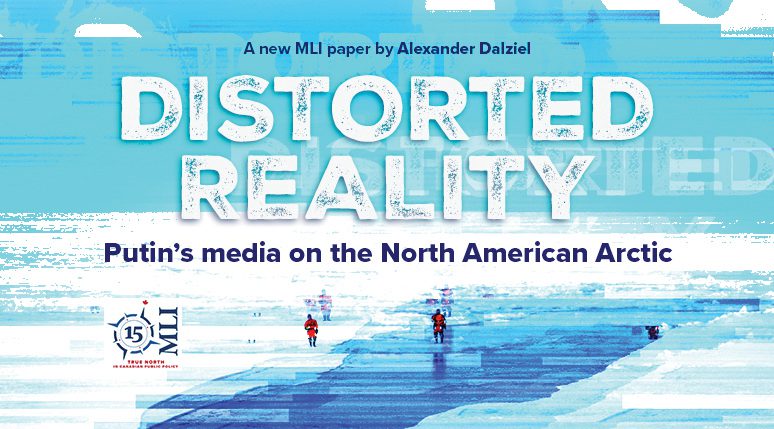
Distorted reality: Putin’s media on the North American Arctic

Alexander Dalziel examines how Russian media presents and frames the North American Arctic as a factor in Russian defence and security to the Russian public.

September 30, 2025
in National Security, Foreign Policy, National Defence, Latest News, Alexander Dalziel, Europe and Russia, Papers, North America, Arctic
Reading Time: 7 mins read
A A
Distorted reality: Putin’s media on the North American Arctic

By Alexander Dalziel

September 30, 2025

PDF of paper

Executive Summary | Sommaire (le français suit)

In a recent speech on the Arctic in Murmansk, Russian President Vladimir Putin warned the audience about the threat posed by Western Arctic nations and their NATO allies. He accused NATO of seeking to establish a “bridgehead for possible conflicts” in the Far North. Putin claimed that the polar region should be peaceful, marked by international collaboration and mutual good will between Arctic nations. However, he failed to mention his own country’s dubious record at peace-making. Putin also neglected to comment on Russia’s illegal and unprovoked invasion and ongoing war against Ukraine, and forgot to mention his own country’s rapid military expansion in the region.

Putin’s rhetoric reflects the wider media narrative in Russia – that Western Arctic nations Canada, the United States, and the Kingdom of Denmark (which includes Denmark, Greenland, and the Faroe Islands) pose a direct threat to Russian ambitions in region.

Since Putin maintains an iron grip over Russian media, his anti-Western views have been reflected by major media outlets like Krasnaya Zvezda, Rossiyskaya Gazeta, and Independent Military Review – the first two state-run, the last notionally independent but tied to the Putin regime. All three media organizations have offered distorted images of the North American Arctic. In their warped lens, Canada, the US, and the Kingdom of Denmark are conspiring with NATO allies to militarize the region in order to hem in Russia and strangle its economic opportunities. The Russian media’s anti-Western rhetoric has grown steadily worse over the past decade. News outlets regularly portray the US as a puppet master, aggressively building up heavily armed bridgeheads in Alaska, northern Canada, and Greenland to hold back a Russia characterized as a legitimate, co-operative Arctic country. When the US talks about “deterrence,” the Russian press interprets it as military and economic containment. As for Russia’s own military buildup, the media claims it is a legitimate response to counter the aggression and ambitions of North American Arctic countries, especially Canada and the United States. In other words, the West has left Putin with no other choice but to militarize the polar region. These sources never mention Russia’s aggression in Ukraine as a destabilizing factor.

Russian media typically portray Canada, Denmark, and Greenland – when it considers them at all – as passive pawns in the US’s larger geopolitical game in the Arctic. This view came to dominate by the end of the past decade.

Certain actions and events commanded Russian media attention however, including Canadian-Danish collaboration in advancing their claims to parts of the Central Arctic seabed, or their intent to work together to build new icebreakers and ice-capable navy patrol ships. Russia media also certainly noticed US President Donald Trump’s disruptive goal to buy Greenland, first articulated in 2019 and then later escalated by Trump in 2024 and 2025 following his re-election. Indeed, Russian media sought to exacerbate the divide between the US and Denmark by highlighting the unpopularity of the US position in Greenland.

It’s important to note, not everything Russian media organizations say are lies. There is also a limited if superficial diversity of opinion, reflecting a state-managed media space, not freedom of thought. But the lens they apply constantly distorts the intentions and activities of North America’s Arctic countries.

There is not much that Canada, the US, Greenland, or Denmark can do change the behaviour of Russian media, distorted as it is by Putin’s authoritarian politics. Two lines of effort, however, will strengthen the resilience of the North American Arctic in the face of Russia’s misrepresentations and set the record straight on the sort of region they collectively want to see:

• First, to counter false and imposed Russian impressions of the North American Arctic, Canada, the US, and the Kingdom of Denmark must present a clear, accurate, vision for the region. That collective effort should include contributions from Indigenous communities and state, provincial, and territorial governments, in order to effectively combat Russian propaganda.

• Second and relatedly, Canada and the US should collaborate closely with the Kingdom of Denmark, respecting Greenland’s self-determination and the division of authority between Nuuk and Copenhagen, to create a trilateral security agenda for the North American Arctic. This agenda should look towards covering aerospace, maritime, economic and human security and the range of threats in these fields our countries face.


Lors d’une allocution récente sur l’Arctique présentée à Mourmansk, le président russe Vladimir Poutine a formulé une mise en garde contre les pays de l’Arctique occidental et leurs alliés de l’OTAN. Il a accusé l’OTAN de vouloir établir un « point d’appui pour des conflits futurs » dans le Grand Nord.

Poutine a affirmé que la région polaire devait être un lieu de paix, de collaboration internationale et de respect mutuel. Il a cependant passé sous silence les résultats peu glorieux de son propre pays en matière de maintien de la paix. Il a également omis de commenter l’invasion russe et la guerre actuelle, illégale et injustifiée, que son pays mène contre l’Ukraine, de même que le déploiement rapide de ses forces militaires dans la région.

La rhétorique de Poutine est à l’image du discours des médias russes, à savoir du danger immédiat que pose l’Arctique occidental – le Canada, les États-Unis et le Royaume du Danemark (y compris le Danemark, le Groenland et les îles Féroé) – pour les aspirations de la Russie.

Poutine, qui contrôle les médias russes d’une main de fer, a vu ses points de vue anti-occidentaux relayés par des organes de presse majeurs comme Krasnaya Zvezda, Rossiyskaya Gazeta et Independent Military Review. L’État supervise les deux premiers et le troisième reste lié au régime de Poutine malgré son indépendance officielle. Les trois ont présenté des images déformées de l’Arctique nord-américain. D’après l’un d’eux, le Canada, les États-Unis et le Royaume du Danemark, en accord avec leurs alliés de l’OTAN, auraient convenu de militariser la région pour isoler la Russie et limiter ses possibilités économiques.

L’hostilité des médias russes à l’égard de l’Occident n’a cessé d’augmenter au cours de la décennie. Ils décrivent souvent les États-Unis comme un marionnettiste qui empile les bases militaires puissamment équipées en Alaska, dans le Grand Nord canadien et au Groenland pour contrer une Russie vue comme un acteur légitime et coopératif dans l’Arctique. Lorsque les États-Unis parlent de « dissuasion », la presse russe y perçoit une forme d’endiguement militaire et économique. Concernant le déploiement militaire proprement russe, la presse insiste sur sa légitimité en invoquant les agressions et les ambitions de l’Arctique nord-américain, en particulier le Canada et les États-Unis. Autrement dit, l’Occident aurait contraint Poutine à militariser la région polaire. Ces sources ne mentionnent jamais la guerre menée par la Russie en Ukraine comme un facteur d’instabilité.

Les médias russes ont l’habitude de représenter le Canada, le Danemark et le Groenland – lorsqu’ils les prennent tous en compte – comme des pions dans la vaste stratégie géopolitique américaine en Arctique. Ce point de vue est devenu plus fréquent depuis dix ans.

Cependant, certains faits et gestes ont attiré l’attention des médias russes, comme la collaboration entre le Canada et le Danemark pour revendiquer des zones du fond marin au cœur de l’Arctique ou, encore, leur projet commun de nouveaux brise-glaces et navires de patrouille capables d’opérer dans les eaux gelées. Les médias russes ont presque certainement aussi noté les revendications hégémoniques du président américain Donald Trump sur le Groenland, d’abord évoquées en 2019, puis renforcées en 2024 après sa réélection. Les médias russes ont effectivement tenté d’accentuer la division entre les États-Unis et le Danemark en insistant sur la désapprobation de la position américaine sur le Groenland.

Il faut souligner que les médias russes ne sont pas totalement mensongers. Il y a également une gradation d’opinions plus ou moins filtrées ou futiles qui témoignent d’un paysage médiatique dominé par l’État, non pas d’une liberté d’expression. Mais les points de vue sont toujours fortement déformés.

Le Canada, les États-Unis, le Groenland et même le Danemark n’ont guère la possibilité d’influer sur les médias russes, biaisés en l’état actuel par les politiques autocratiques de Poutine. Toutefois, pour renforcer la résilience de l’Arctique nordaméricain face à la désinformation et définir clairement l’ordre régional souhaité, les deux axes de travail que voici sont envisagés :

• D’abord, pour contrer les fausses perceptions sur l’Arctique nord-américain imposées par la Russie, le Canada, les États-Unis et le Royaume du Danemark doivent dresser un portrait réaliste et précis de la région. Pour lutter efficacement contre la propagande russe, il faut inclure les contributions des collectivités autochtones ainsi que des autorités étatiques, provinciales et territoriales.

• Ensuite, le Canada et les États-Unis doivent collaborer étroitement avec le Royaume du Danemark, en respectant l’autodétermination du Groenland et le partage des pouvoirs entre Nuuk et Copenhague, dans le but de mettre en place un plan de sécurité trilatéral pour l’Arctique nord-américain. Ce plan doit englober la sécurité aérospatiale, maritime, économique et humaine, en tenant compte de la diversité des menaces qui pèsent sur nos pays.

 

Related Posts

Property rights are “precarious” in Canada: Paul Warchuk and Peter Copeland for Inside Policy Talks
Domestic Policy

Property rights are “precarious” in Canada: Paul Warchuk and Peter Copeland for Inside Policy Talks

December 4, 2025
Harvard eschews ingrained ideology in order to tackle ‘genuinely hard problems’: Peter MacKinnon in the National Post
Reforming Universities

Harvard eschews ingrained ideology in order to tackle ‘genuinely hard problems’: Peter MacKinnon in the National Post

December 3, 2025
Risking public backlash? Canadian universities and demographic-based faculty hiring
Education

Risking public backlash? Canadian universities and demographic-based faculty hiring

December 3, 2025
Next Post
The CCP’s hybrid warfare is already here: Dean Baxendale and Garry Clement in National Newswatch

The CCP’s hybrid warfare is already here: Dean Baxendale and Garry Clement in National Newswatch

Newsletter Signup

  Thank you for Signing Up
  Please correct the marked field(s) below.
Email Address  *
1,true,6,Contact Email,2
First Name *
1,true,1,First Name,2
Last Name *
1,true,1,Last Name,2
*
*Required Fields

Follow us on

Macdonald-Laurier Institute

323 Chapel Street, Suite #300
Ottawa, Ontario, K1N 7Z2 Canada

613.482.8327

info@macdonaldlaurier.ca
MLI directory

Support Us

Support the Macdonald-Laurier Institute to help ensure that Canada is one of the best governed countries in the world. Click below to learn more or become a sponsor.

Support Us

  • Inside Policy Magazine
  • Annual Reports
  • Jobs
  • Privacy Policy

© 2023 Macdonald-Laurier Institute. All Rights reserved.

No Result
View All Result
  • Home
  • About
    • Who We Are
    • Who Makes MLI Work
    • Fifteenth Anniversary
  • Experts
    • Experts Directory
    • In Memoriam
  • Issues
    • Domestic Policy
      • Economic Policy
      • Justice
      • Rights and Freedoms
      • Assisted Suicide (MAID)
      • Health Care
      • COVID-19
      • Gender Identity
      • Canada’s Political Tradition
      • AI, Technology and Innovation
      • Media and Telecoms
      • Housing
      • Immigration
      • Agriculture and Agri-Food
      • Competition Policy
    • Energy Policy
      • Energy
      • Environment
    • Foreign Policy
      • Israel-Hamas War
      • Ukraine
      • Taiwan
      • China
      • Europe and Russia
      • Indo-Pacific
      • Middle East and North Africa
      • North America
      • Foreign Interference
      • National Defence
      • National Security
      • Foreign Affairs
    • Indigenous Affairs
  • Projects
    • CNAPS (Center for North American Prosperity and Security)
    • The Promised Land
    • Voices that Inspire: The Macdonald-Laurier Vancouver Speaker Series
    • Dragon at the door
    • Canada on top of the world
    • Letter to a minister
    • Justice Report Card
    • The Great Energy Crisis
    • DisInfoWatch.org
    • Managing Indigenous Prosperity
    • Judicial Foundations
    • Landmark Cases Council
    • Defending The Marketplace of Ideas
    • Reforming the University
    • Past Projects
      • Digital Policy & Connectivity
      • Double Trouble
      • Canada and the Indo-Pacific Initiative
      • The Transatlantic Program
      • COVID Misery Index
      • Speak for Ourselves
      • The Eavesdropping Dragon: Huawei
      • Talkin’ in the Free World with Mariam Memarsadeghi
      • An Intellectual Property Strategy for Canada
      • Munk Senior Fellows
      • A Mandate for Canada
      • Confederation Series
      • Fiscal Reform
      • The Canadian Century project
      • Fixing Canadian health care
      • Internal trade
      • From a mandate for change
      • Size of government in Canada
      • Straight Talk
      • Labour Market Report
      • Leading Economic Indicator
      • Centre for Advancing Canada’s Interests Abroad
      • Indigenous Prosperity at a Crossroads
  • Events
    • Upcoming Events
    • Past Events
      • MLI Dinners
      • Great Canadian Debates
  • Latest News
  • Libraries
    • Columns
    • Commentary
    • Papers
    • Books
    • Video
  • Donate

© 2023 Macdonald-Laurier Institute. All Rights reserved.