Wednesday, April 1, 2026
No Result
View All Result
  • Media
Macdonald-Laurier Institute
  • Home
  • About
    • Who We Are
    • Who Makes MLI Work
    • Fifteenth Anniversary
  • Experts
    • Experts Directory
    • In Memoriam
  • Issues
    • Domestic Policy
      • Economic Policy
      • Justice
      • Rights and Freedoms
      • Assisted Suicide (MAID)
      • Health Care
      • COVID-19
      • Gender Identity
      • Canada’s Political Tradition
      • AI, Technology and Innovation
      • Media and Telecoms
      • Housing
      • Immigration
      • Agriculture and Agri-Food
      • Competition Policy
    • Energy Policy
      • Energy
      • Environment
    • Foreign Policy
      • Israel-Hamas War
      • Ukraine
      • Taiwan
      • China
      • Europe and Russia
      • Indo-Pacific
      • Middle East and North Africa
      • North America
      • Foreign Interference
      • National Defence
      • National Security
      • Foreign Affairs
    • Indigenous Affairs
  • Projects
    • CNAPS (Center for North American Prosperity and Security)
    • Justice Report Card
    • The Promised Land
    • Voices that Inspire: The Macdonald-Laurier Vancouver Speaker Series
    • Dragon at the door
    • Canada on top of the world
    • Letter to a minister
    • The Great Energy Crisis
    • DisInfoWatch.org
    • Managing Indigenous Prosperity
    • Judicial Foundations
    • Landmark Cases Council
    • Defending The Marketplace of Ideas
    • Reforming the University
    • Past Projects
      • Digital Policy & Connectivity
      • Double Trouble
      • Canada and the Indo-Pacific Initiative
      • The Transatlantic Program
      • COVID Misery Index
        • Provincial COVID Misery Index
        • Beyond Lockdown
        • COVID and after: A mandate for recovery
      • Speak for Ourselves
      • The Eavesdropping Dragon: Huawei
      • Talkin’ in the Free World with Mariam Memarsadeghi
      • An Intellectual Property Strategy for Canada
      • Munk Senior Fellows
      • A Mandate for Canada
      • Confederation Series
      • Fiscal Reform
      • The Canadian Century project
      • Fixing Canadian health care
      • Internal trade
      • From a mandate for change
      • Size of government in Canada
      • Straight Talk
      • Labour Market Report
      • Leading Economic Indicator
      • Centre for Advancing Canada’s Interests Abroad
      • Indigenous Prosperity at a Crossroads
        • Aboriginal Canada and Natural Resources
  • Events
    • Upcoming Events
    • Past Events
      • MLI Dinners
      • Great Canadian Debates
  • Latest News
  • Libraries
    • Columns
    • Commentary
    • Papers
    • Books
    • Video
  • Donate
  • Home
  • About
    • Who We Are
    • Who Makes MLI Work
    • Fifteenth Anniversary
  • Experts
    • Experts Directory
    • In Memoriam
  • Issues
    • Domestic Policy
      • Economic Policy
      • Justice
      • Rights and Freedoms
      • Assisted Suicide (MAID)
      • Health Care
      • COVID-19
      • Gender Identity
      • Canada’s Political Tradition
      • AI, Technology and Innovation
      • Media and Telecoms
      • Housing
      • Immigration
      • Agriculture and Agri-Food
      • Competition Policy
    • Energy Policy
      • Energy
      • Environment
    • Foreign Policy
      • Israel-Hamas War
      • Ukraine
      • Taiwan
      • China
      • Europe and Russia
      • Indo-Pacific
      • Middle East and North Africa
      • North America
      • Foreign Interference
      • National Defence
      • National Security
      • Foreign Affairs
    • Indigenous Affairs
  • Projects
    • CNAPS (Center for North American Prosperity and Security)
    • Justice Report Card
    • The Promised Land
    • Voices that Inspire: The Macdonald-Laurier Vancouver Speaker Series
    • Dragon at the door
    • Canada on top of the world
    • Letter to a minister
    • The Great Energy Crisis
    • DisInfoWatch.org
    • Managing Indigenous Prosperity
    • Judicial Foundations
    • Landmark Cases Council
    • Defending The Marketplace of Ideas
    • Reforming the University
    • Past Projects
      • Digital Policy & Connectivity
      • Double Trouble
      • Canada and the Indo-Pacific Initiative
      • The Transatlantic Program
      • COVID Misery Index
        • Provincial COVID Misery Index
        • Beyond Lockdown
        • COVID and after: A mandate for recovery
      • Speak for Ourselves
      • The Eavesdropping Dragon: Huawei
      • Talkin’ in the Free World with Mariam Memarsadeghi
      • An Intellectual Property Strategy for Canada
      • Munk Senior Fellows
      • A Mandate for Canada
      • Confederation Series
      • Fiscal Reform
      • The Canadian Century project
      • Fixing Canadian health care
      • Internal trade
      • From a mandate for change
      • Size of government in Canada
      • Straight Talk
      • Labour Market Report
      • Leading Economic Indicator
      • Centre for Advancing Canada’s Interests Abroad
      • Indigenous Prosperity at a Crossroads
        • Aboriginal Canada and Natural Resources
  • Events
    • Upcoming Events
    • Past Events
      • MLI Dinners
      • Great Canadian Debates
  • Latest News
  • Libraries
    • Columns
    • Commentary
    • Papers
    • Books
    • Video
  • Donate
No Result
View All Result
Macdonald-Laurier Institute

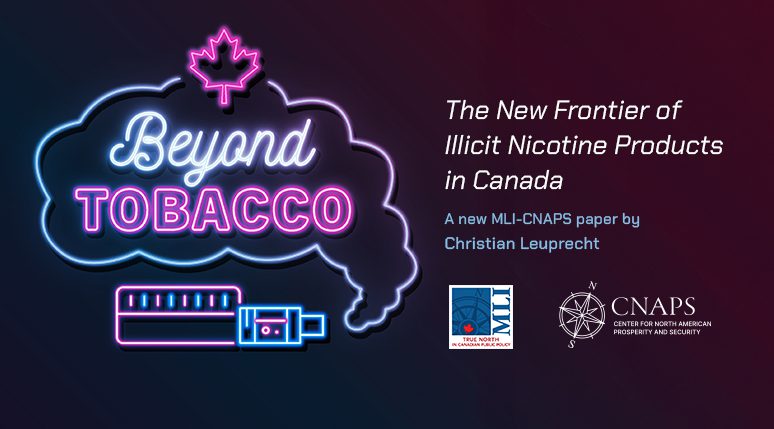
Beyond tobacco – The new frontier of illicit nicotine products in Canada

Fragmented regulation, uneven enforcement, and the rise of e-commerce have created structural vulnerabilities that illicit actors are exploiting at scale.

March 12, 2026
in Domestic Policy, Latest News, Papers, Health, Justice, Christian Leuprecht
Reading Time: 6 mins read
A A
Beyond tobacco – The new frontier of illicit nicotine products in Canada

By Christian Leuprecht

March 12, 2026

PDF of paper

Executive Summary | Sommaire (le français suit)

Canada is confronting a rapidly expanding illicit nicotine market that has evolved well beyond traditional contraband tobacco. Criminal networks that once focused on cigarettes now traffic in high-nicotine disposable vapes, unauthorized nicotine pouches, and a sprawling ecosystem of online black market platforms. Fragmented regulation, uneven enforcement, and the rise of e-commerce have created structural vulnerabilities that illicit actors are exploiting at scale.

The study shows that illicit nicotine products are now distributed through the same channels long used for contraband tobacco – cross-border smuggling, grey-market wholesalers, on-reserve and off-reserve storefronts, and increasingly, anonymous online vendors. Enforcement data and a national retail compliance sweep across seven provinces reveal extensive non-compliance, particularly in British Columbia, Alberta, and Quebec, where oversized disposable vapes, mislabelled nicotine strengths, and illegal high-nicotine pouches are widely available. In many cases, products are concealed in back rooms or offered “off menu,” which signals deliberate evasion rather than misunderstanding of regulations.

A central finding is the transformative role of online commerce. Hundreds of websites – many purporting to be Indigenous-owned – openly sell contraband cigarettes, illicit vapes, and unauthorized nicotine pouches, often alongside narcotics, all shipped through unmarked parcel post with no age verification. This digital infrastructure mirrors, and magnifies, the spread of contraband tobacco. Criminal actors leverage sophisticated marketing, payment processing, and logistics systems to normalize illicit purchases and reduce the chance of being caught.

Public-health consequences are significant. Unregulated vaping products often exceed nicotine concentration limits, contain undisclosed ingredients or contaminants, and lack safety standards for packaging, labelling, and battery integrity. Unauthorized nicotine pouches – many imported from Europe, the US, or China – frequently exceed safe nicotine levels, raising risks of poisoning, rapid dependence, and youth uptake. Youth remain especially vulnerable, with evidence of social-media-enabled sales directly targeting minors.

Fiscal harms are equally consequential. Governments lose excise, provincial duty, HST/GST, and income-tax revenue, while compliant retailers are undercut by untaxed competitors. In provinces with aggressive restrictions, such as Quebec’s flavour ban and 2 mL capacity limit, regulatory asymmetry has encouraged large-scale circumvention rather than compliance, with interprovincial e-commerce pipelines supplying prohibited products.

The study finds that Canada’s enforcement framework – last meaningfully updated in the mid-2010s for contraband tobacco – has not kept pace with the diversification of illicit nicotine markets. Provinces vary widely in inspection capacity and tax-stamp rules; regulatory fragmentation creates criminogenic asymmetries and jurisdictional arbitrage: bad actors seek to gain a competitive advantage, such as lower taxes, reduced operating costs, or laxer standards, by exploiting different legal, tax, or regulatory regimes across different jurisdictions. Without coherent federal leadership, enforcement remains reactive, fragmented, and easily bypassed.

To reverse these trends, the study recommends:

• Prioritizing illicit online sales through coordinated actions targeting payment processing, hosting infrastructure, and postal logistics.

• Establishing a national Illicit Nicotine Task Force that unifies federal, provincial, and law-enforcement partners under a shared strategy with measurable targets.

• Strengthening legal authorities over nicotine pouches by defining them clearly in federal law, empowering CBSA, and imposing escalating penalties.

• Closing loopholes in vaping regulation, aligning definitions, restricting flavourshot workarounds, tightening tax-stamp systems, and expanding inspection powers.

• Enhancing public awareness, including youth-focused prevention, educating retailers, and publicized enforcement actions.

Absent decisive action, the illicit nicotine economy risks becoming entrenched – replicating the trajectory of contraband tobacco, undermining public health, draining public revenues, and strengthening organized crime networks. The study makes a case for coordinated leadership, modernized legislation, and targeted enforcement to restore regulatory integrity and protect Canadians.


Le marché illicite de la nicotine prend de l’ampleur au Canada, éclipsant désormais la contrebande de tabac traditionnel. Les réseaux criminels préfèrent maintenant les vapoteuses jetables et les sachets à forte concentration, en exploitant un vaste écosystème numérique au service du commerce clandestin. La fragmentation de la réglementation, l’inégalité d’application des lois et l’essor du commerce en ligne ont créé des failles que les acteurs illégaux exploitent à grande échelle.

L’étude révèle que les produits de nicotine illicites empruntent les mêmes voies que le tabac de contrebande historiquement : passeurs transfrontaliers, grossistes semiclandestins, comptoirs dans et hors des réserves et vendeurs en ligne anonymes, de plus en plus sollicités. Les données et un survol de la conformité des points de vente à travers sept provinces mettent en évidence de nombreuses infractions, notamment en ColombieBritannique, en Alberta et au Québec : vapoteuses surdimensionnées, concentrations non déclarées et sachets illégaux. Souvent, ces produits sont cachés ou vendus “hors carte”, indiquant une intention de déjouer plutôt qu’une méconnaissance des règles.

Le rôle du commerce en ligne est transformateur. Des centaines de  sites Web ‒ prétendument autochtones ‒ vendent ouvertement des cigarettes de contrebande, des vapoteuses illicites et des sachets interdits sans vérifier l’âge, parfois même  des stupéfiants, et les expédient sans marquage. Cette infrastructure révèle et  amplifie le rayonnement du tabac de contrebande. Les criminels exploitent des techniques de marketing, de paiement et de logistique sophistiquées pour faciliter les achats illégaux et minimiser les risques.

Les impacts de santé publique sont considérables. Les produits de vapotage non réglementés excèdent fréquemment  les concentrations de nicotine autorisées, contiennent des ingrédients non déclarés ou des contaminants, et contreviennent aux normes de sécurité d’emballage, d’étiquetage et d’intégrité (batterie). Les sachets non autorisés ‒ principalement importés d’Europe, des États-Unis ou de Chine ‒ augmentent d’autant les risques d’empoisonnement, de dépendance et de consommation chez les jeunes, ciblés sur les réseaux sociaux.

Les préjudices fiscaux sont tous aussi importants. Les gouvernements perdent droits d’accise, taxes provinciales, TPS/ TVH et impôts sur le revenu, tandis que les détaillants conformes subissent une concurrence déloyale. Là où les contraintes sont les plus fortes (interdiction des arômes et limite de 2 ml au Québec), le contournement des règles est devenu la norme, favorisé par l’essor du commerce électronique interprovincial qui exploite cette asymétrie réglementaire.

L’étude montre que la loi n’a pas évolué de pair avec la diversification des marchés illicites depuis les années 2010. En outre, les différences entre les provinces en termes d’inspection, de taxation et de réglementation favorisent les comportements criminels et la concurrence fiscale ‒ au sens où les acteurs malveillants cherchent à exploiter les différences entre les régimes légaux, fiscaux et réglementaires des diverses autorités pour obtenir un avantage concurrentiel sous forme de baisses d’impôt, de coûts d’exploitation moindres ou de normes plus clémentes. Sans leadership fédéral cohérent, l’application de la loi reste réactive, fragmentée et aisément contournable.

Pour inverser ces tendances, l’étude propose les actions suivantes :

• Prioriser la lutte contre les ventes illicites en ligne au moyen d’actions concertées visant les processus de paiement, d’hébergement Web et de logistique postale.

• Créer un groupe de travail national sur la nicotine rassemblant tous les partenaires (fédéraux – provinciaux – instances juridiques) pour une stratégie commune et des objectifs mesurables.

• Définir les pouvoirs juridiques sur les sachets dans la législation fédérale, tout en responsabilisant l’Agence des services frontaliers du Canada et en imposant des sanctions graduelles.

• Éliminer les lacunes réglementaires en harmonisant les définitions, en interdisant les solutions de contournement relatives aux arômes, en renforçant les droits de taxation et en élargissant les pouvoirs d’inspection.

• Sensibiliser le public, accentuer la prévention chez les jeunes, informer les détaillants et rendre publiques les mesures d’application de la loi.

Sans mesures décisives, l’économie souterraine risque de pérenniser la nicotine illicite  ‒reproduisant l’évolution du tabac de contrebande, portant préjudice à la santé publique, diminuant les recettes étatiques et renforçant les réseaux criminels. L’étude recommande un leadership concerté, une législation modernisée et une application ciblée de la loi pour rétablir l’intégrité réglementaire et protéger les Canadiennes et les Canadiens.


 

Related Posts

Objections notwithstanding, the constitutional clause is OK: Philip Cross in the Financial Post
Justice

Fire any Supreme Court judge that tries to put limits on Section 33: Yuan Yi Zhu in the National Post

April 1, 2026
The fiscal challenge Canada’s provinces don’t want you to talk about: Trevor Tombe in The Hub
Economic Policy

The fiscal challenge Canada’s provinces don’t want you to talk about: Trevor Tombe in The Hub

April 1, 2026
Assisted Suicide (MAID)

Better dead than disabled? Alberta finally draws the line on MAiD: Gabrielle Peters for Inside Policy

April 1, 2026
Next Post
How Canadian universities can avoid the American dumpster fire of de-woking: Christopher Dummitt in the National Post

Political agendas have no place in university research applications: Peter MacKinnon in the National Post

Newsletter Signup

  Thank you for Signing Up
  Please correct the marked field(s) below.
Email Address  *
1,true,6,Contact Email,2
First Name *
1,true,1,First Name,2
Last Name *
1,true,1,Last Name,2
*
*Required Fields

Follow us on

Macdonald-Laurier Institute

323 Chapel Street, Suite #300
Ottawa, Ontario, K1N 7Z2 Canada

613.482.8327

info@macdonaldlaurier.ca
MLI directory

Support Us

Support the Macdonald-Laurier Institute to help ensure that Canada is one of the best governed countries in the world. Click below to learn more or become a sponsor.

Support Us

  • Inside Policy Magazine
  • Annual Reports
  • Jobs
  • Privacy Policy

© 2023 Macdonald-Laurier Institute. All Rights reserved.

No Result
View All Result
  • Home
  • About
    • Who We Are
    • Who Makes MLI Work
    • Fifteenth Anniversary
  • Experts
    • Experts Directory
    • In Memoriam
  • Issues
    • Domestic Policy
      • Economic Policy
      • Justice
      • Rights and Freedoms
      • Assisted Suicide (MAID)
      • Health Care
      • COVID-19
      • Gender Identity
      • Canada’s Political Tradition
      • AI, Technology and Innovation
      • Media and Telecoms
      • Housing
      • Immigration
      • Agriculture and Agri-Food
      • Competition Policy
    • Energy Policy
      • Energy
      • Environment
    • Foreign Policy
      • Israel-Hamas War
      • Ukraine
      • Taiwan
      • China
      • Europe and Russia
      • Indo-Pacific
      • Middle East and North Africa
      • North America
      • Foreign Interference
      • National Defence
      • National Security
      • Foreign Affairs
    • Indigenous Affairs
  • Projects
    • CNAPS (Center for North American Prosperity and Security)
    • Justice Report Card
    • The Promised Land
    • Voices that Inspire: The Macdonald-Laurier Vancouver Speaker Series
    • Dragon at the door
    • Canada on top of the world
    • Letter to a minister
    • The Great Energy Crisis
    • DisInfoWatch.org
    • Managing Indigenous Prosperity
    • Judicial Foundations
    • Landmark Cases Council
    • Defending The Marketplace of Ideas
    • Reforming the University
    • Past Projects
      • Digital Policy & Connectivity
      • Double Trouble
      • Canada and the Indo-Pacific Initiative
      • The Transatlantic Program
      • COVID Misery Index
      • Speak for Ourselves
      • The Eavesdropping Dragon: Huawei
      • Talkin’ in the Free World with Mariam Memarsadeghi
      • An Intellectual Property Strategy for Canada
      • Munk Senior Fellows
      • A Mandate for Canada
      • Confederation Series
      • Fiscal Reform
      • The Canadian Century project
      • Fixing Canadian health care
      • Internal trade
      • From a mandate for change
      • Size of government in Canada
      • Straight Talk
      • Labour Market Report
      • Leading Economic Indicator
      • Centre for Advancing Canada’s Interests Abroad
      • Indigenous Prosperity at a Crossroads
  • Events
    • Upcoming Events
    • Past Events
      • MLI Dinners
      • Great Canadian Debates
  • Latest News
  • Libraries
    • Columns
    • Commentary
    • Papers
    • Books
    • Video
  • Donate

© 2023 Macdonald-Laurier Institute. All Rights reserved.