This article originally appeared in The Hub.
By Trevor Tombe, April 23, 2026
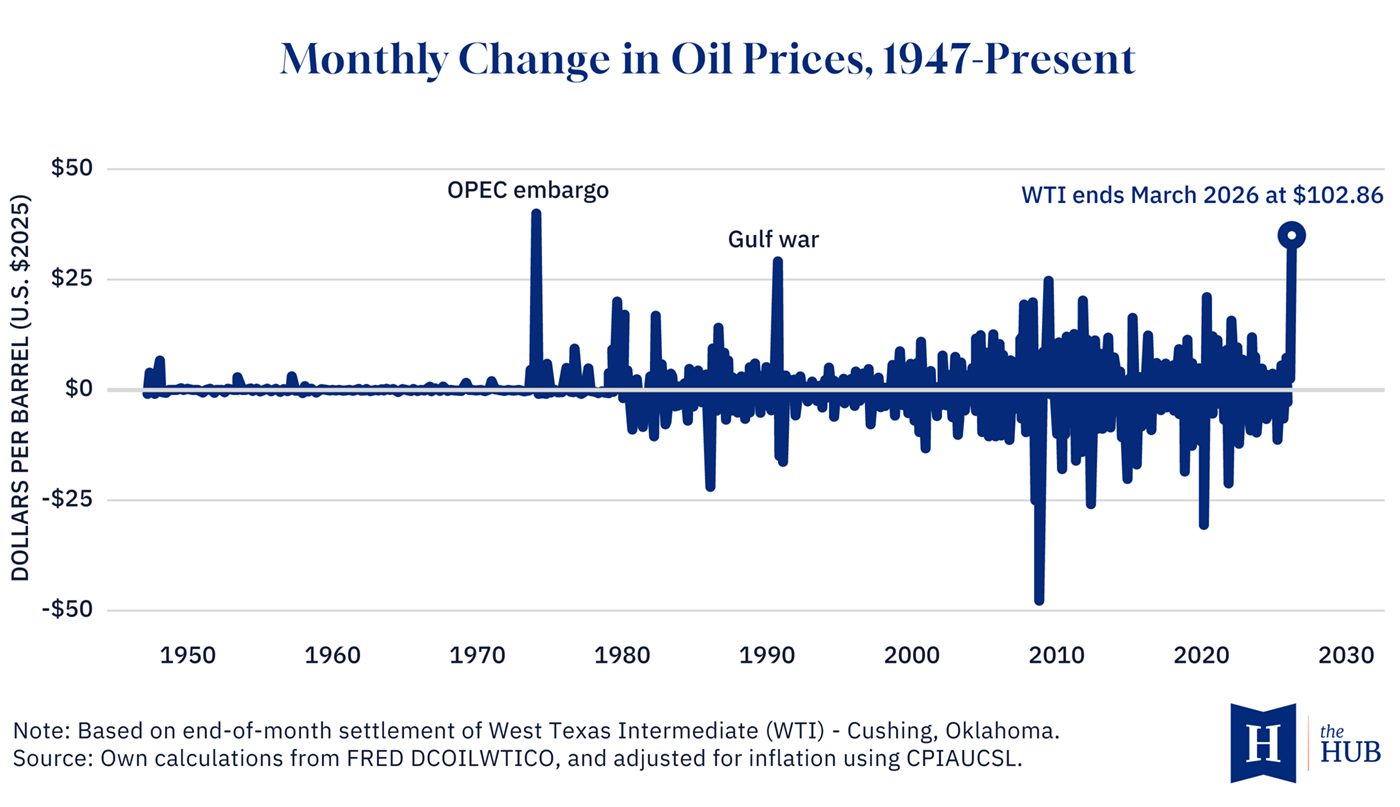
Following the start of the U.S.-Iran war in late February, oil prices around the world rose rapidly. By the end of March, the per-barrel price of oil had increased at the second-fastest monthly pace in history, exceeded only by the early months of the OPEC embargo in the 1970s.
The effect on gasoline and overall inflation was just as significant, and just as swift.
Oil prices surge, inflation follows
In data released on Monday, Statistics Canada found that gasoline prices across Canada increased by more than 21 percent on a monthly basis in March. This was, in its words, “the largest price increase for gasoline on record.”
The result was also to push overall consumer price growth to 2.4 percent in March, up from 1.8 percent a month earlier. And had energy prices remained unchanged, I estimate the recorded inflation rate in March would have been 1.6 percent.
There is still considerable uncertainty over how long high oil prices will last. But the strain this places on Canadians, in terms of the overall cost of living, is clear. Individuals and families feel it directly each time they fill up at the pump. On average, gas prices in March were nearly 30 cents per litre higher than they were in February. The pressure on governments to act has been considerable.
Ottawa’s temporary fuel tax cut
For governments, especially in a small open economy like Canada’s, it is difficult to offset the effects of global shocks on households. But earlier this week, the federal government temporarily suspended the federal gas tax of 10 cents per litre. It also suspended the 4 cents per litre tax on diesel and the federal tax on aviation fuel. Overall, the government estimates this is equivalent to about a $2.4 billion tax cut for Canadians, though only a temporary one, since it remains in effect until after the Labour Day long weekend.
So what is this worth to individuals? Of course, it depends on many factors, from how much one drives to the efficiency of one’s vehicle. There are also indirect effects from slightly lower diesel costs on the price of all kinds of goods shipped by truck, with implications throughout the supply chain.
But overall, the effect of this tax change is somewhat muted.
What this means for households
The average Canadian household purchases about 1,600 litres of gasoline per year, and normally buys about 10 percent more during these affected months than during the rest of the year. That means the average household will see 10 cents per litre less on roughly 650 litres of gasoline purchased between now and Labour Day. Overall savings are therefore about $65, or roughly $16 per month.
Of course, some will see larger gains than this. In general, higher-income households tend to drive more than lower-income households. Using some of the latest available tax modelling software from Statistics Canada, I estimate that average savings for those earning under $60,000 would be approximately $40 in total between now and Labour Day. For those earning over $180,000 per year, the savings would be roughly triple that.
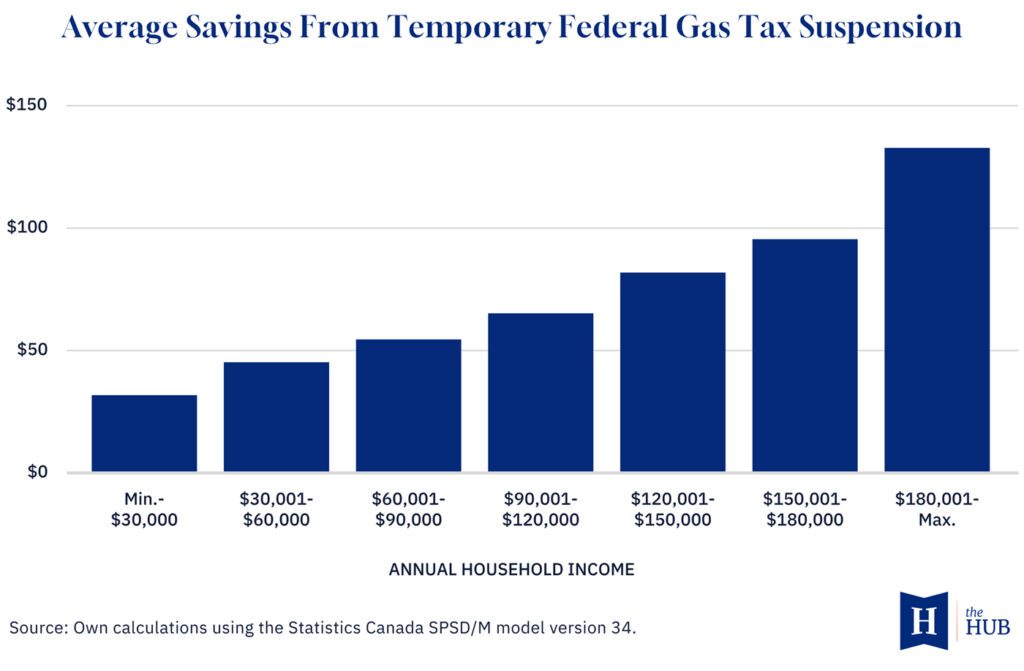
As a share of overall income, however, the effects are larger for lower-income households. In that sense, this could be characterized as a progressive tax cut. For those earning less than $30,000 per year, the savings are equal to approximately 0.15 percent of annual income. For those earning more than $180,000 per year, the average savings are equivalent to about 0.05 percent of income.
The budget impact
What does this mean for the federal government’s budget? The government collects nearly $6 billion per year from its taxes on gasoline, diesel, and aviation fuel, with the overwhelming majority coming from the gas tax.
Does this move risk increasing the federal deficit?
Many provinces benefit directly from high oil prices through the royalties they levy on the value of output, with Alberta standing out in particular as a beneficiary of these sharp increases. But the federal government benefits as well. Canada, after all, produces roughly two billion barrels of oil per year. And with oil prices now roughly $20 per barrel higher than what the government anticipated when it tabled its budget back in November, profits for oil and gas companies will be higher too. Given the federal government’s 15 percent corporate income tax, that means roughly $500 million per month now in additional federal revenue (and more when oil prices were higher through much of March).
So if oil prices remain roughly where they are now through Labour Day, and who knows whether that will occur, the federal government will receive additional revenues that more than offset the cost of its temporary fuel tax suspension. Depending on how long high oil prices last, Ottawa has effectively deployed its fiscal windfall through this fuel tax change.
If high oil prices persist, Ottawa may have room to do even more.
Trevor Tombe is a professor of economics at the University of Calgary, the Director of Fiscal and Economic Policy at The School of Public Policy, a Senior Fellow at the Macdonald-Laurier Institute, and a Fellow at the Public Policy Forum.